Congrats! You’ve Just Been Nurtured (And It Feels Super Gross)

At the risk of being that cliché person posting about how something personal taught me a professional lesson (like how rolling my ankle and falling into the pool taught me how to be a better leader, or how my dog throwing up on the carpet taught me the key to faster sales cycles,) I’m going to do just that. 😀

As Product Marketers, we live and breathe problem-solution messaging frameworks. It’s foundational for showing buyers we understand their pain and have a remedy. But lately, I’ve noticed a disturbing trend here where the “product” in this formula is the job seeker. 

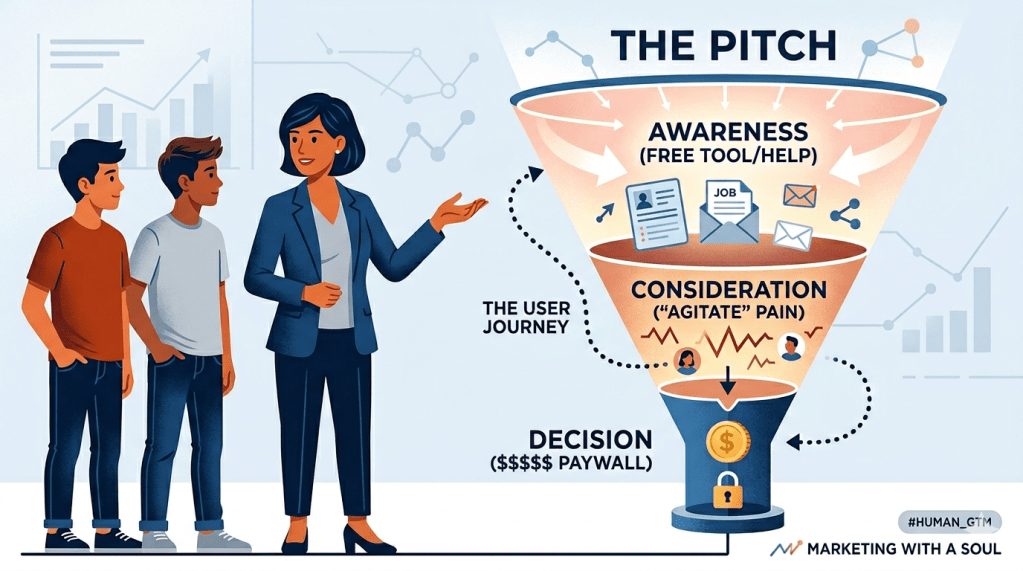
If you’ve been on social media for more than five minutes, you’ve seen the PAS playbook. It looks like this:

The Problem

It starts with a kind offer or suggestion. In this case, a person introduces you to a hiring manager. Or someone in your profession posts about the best resume formatting. It’s designed to identify the most high-intent audience possible: people who are raising their hands to say, “I am unemployed and down on my luck.”

The Agitation

Once they hook you, the messaging shifts to: “I bet you didn’t know this but, the system is rigged. The traditional way is dead. You’re missing the secret sauce.” This person has been posting frequently, creating credibility that may not be reflected in actual experience. You know what I’m talking about… those who can’t do…

The Solve

The solution? An expensive course or super special workshop that will solve all your problems, that you can only get from them. This is value messaging in its most icky version. 🤮 They are banking on people’s logic that “If it’s expensive, this must really be the secret ‘Big Job Board’ has been hiding from me.”


Why this feels off to a seasoned PMM.

As marketers, we know about brand building and the need for lead funneling. However, there is a fine line between empowering a prospect and monetizing their desperation.

When a free offer exists solely to target and funnel vulnerable people into a highly expensive program, we have to ask ourselves: Are they really teaching, or are they just capitalizing on a crisis?

True PMM expertise is built in the trenches of product lifecycles and trust is earned, not exploited.

From networking to nurturing.

There is a certain kind of “aha!” moment that happens during a job search, and it isn’t always a good one. For me, this was the moment I realized a professional connection I valued wasn’t a connection at all.

I started following someone a couple of years ago because I kept seeing their resources shared across my network. This person is brilliant on paper, highly educated and credentialed, and for a while it all felt insightful, genuine and selfless.

Then I hit that landing page. 🤑

Seeing a $1k+ price tag at the end of a “supportive journey” through my unemployment felt like some real BS to me. I’ll be the first to admit I have a low tolerance for fluff, but this was a whole new level. And honestly, it wasn’t even about the money, because I certainly don’t hate capitalism. Capitalism is what allows us to build, innovate, pay our bills, and then do it all again.

It was the bait-and-switch of it all.

When you are in the middle of a job search, your trust is already fragile. You are looking for honesty in a sea of automated rejection emails and late stage ghosting. So, when someone offers what feels like genuine connections and resources, you let your guard down.

Finding out what you thought were real conversations were actually lead magnets designed to funnel vulnerable professionals into a high-ticket sale feels very sneaky. And low.

I still respect the pivot, absolutely admire the hustle. The amount of dedication and follow-through that was required to build this over the last few years is incredible. Truly. But as a marketer, I know the difference between building a community and building a list.

We don’t have to be anti-capitalist to be pro-transparency. You can be smart enough to find a gap in the market without using the heartbreaking stress of a person’s career transition as your way in.

Why I Stay in Marketing Even Though It Sometimes Feels Gross

I spend a lot of time explaining the digital world to my family and my children. I tell them that every click is a breadcrumb. Every decision they make online is quietly curating their next move, whether they realize it or not. I’ve worked with some very political media outlets, where headlines and algorithms, not actual fact and context, drive the most important decisions of our lives.

But lately, I started having a harder conversation with my boys about this type of social engineering. We see it everywhere online: SPIN selling and PAS formulas. It’s used as a system to find people who are stuck, feel worthless, think there is no answer to their problem, and then agitate their pain.

My biggest fear for the next generation isn’t just that they’ll lose money. It’s that when they reach the end of a $1,000 funnel and realize they can’t afford the solution, they walk away thinking they are the problem. That they are unworthy. That the “secret” is real and they just can’t have it.

As a mom, a marketer and a human, this makes my skin crawl and my heart break.

There are days I want to throw my hands up and walk away from this list and spreadsheet approach to human beings.

But then I remember why I pivoted to marketing in the first place.

I didn’t leave the engineering world of “how things work” to join a world of “how to trick people.” I got into marketing because I wanted to solve the problem of “how things work and why it matters to people.” I wanted to understand the depth of a customer’s needs and build bridges that actually lead somewhere. Somewhere genuine.

Throughout my career, I’ve gravitated toward founders with contagious passion. Leaders whose mission is to secure, defend, and protect. When the mission is about safeguarding a person’s life, digital or otherwise, marketing shouldn’t be a trap, it should be a beacon of hope. So, I keep doing this because we need marketers who see the person behind the persona.

At the end of the day, if I can teach my children to spot the tricks and keep their sense of self-worth intact, to know that a price tag is never a measure of their value, that will be the most important GTM strategy I will ever develop. ♥️

#JobSearch #ProductMarketing #MarketingEthics #BeAHuman #SocialEngineering
Wrong Story, Wrong Person, Wrong Time

Maybe it’s this job hunt, or maybe, more likely, it’s my PMM brain in overdrive, but this sales outreach made me feel some kind of way.

For over a month, I’ve been in this automated LinkedIn cadence and haven’t responded. Until today.

The product? An ABM service.

The irony? A 3-second glance at my profile shows I’ve been “Open to Work” since early February and therefore not their target audience.

As a Product Marketer, my job is to enable sellers to tell the right story to the right person at the right time. In fact, I’m passionate about it. Not to be dramatic, but this felt like an assault on my craft. 😅

But here’s the thing: Sales is not for the faint of heart. Right now, many organizations are holding their teams to extreme, often wildly unrealistic quotas. These unrealistic expectations don’t just hurt the brand, they get in the way of people’s livelihoods.

So, I replied to the messages finally. I was not trying to be a Karen about it, I just wanted to share why this outreach wasn’t going to work. To his credit, he responded immediately with kindness and like a human, which he did not have to do. It changed the dynamic so much, he will be the first person I call when I need ABM services.

Here’s what this interaction showed me:

  • The Tech Gap: LinkedIn Campaign Manager lacks native “Stop on Job Change” and “Stop After No Response” triggers. Wild considering in an ABM world, the “who” is the actual point. It’s quite possible his cadence began before my job status changed. Here’s a feature request for you, LinkedIn!
  • The Enablement Gap: If we don’t give our sellers the right tools to tell our value story, we are setting them up to fail.
  • The Empathy Gap: A little human connection goes a very long way, especially when it’s time to consider vendors. 😀 He was not a bot, he was a person doing a tough job in a high-pressure environment.

I’m currently looking for a team that values connection over transactions. If you’re looking for a PMM right now that is passionate about a mission that combines technology, human empathy and storytelling, that’s me! 👋

Side note: I believe GTM needs technology to scale, but fails without human empathy. So while these are my thoughts and my experience, I did use AI to help me proofread and refine the delivery, just like I would when partnering with Content Marketing.

Best of luck to all the sellers and job hunters.

#ProductMarketing #ABM #GTM #SalesEnablement #CustomerObsessed #B2BMarketing #HumanBeings

Yo, This COVID-19 Work From Home Situation…

One day I’ll have time to make another post about an amazing workshop I attended or an informative book I read. Today is not that day. Today I am trying to survive. And now that our Tennessee governor is officially signing an order requiring us to stay home, it has become all too real. We are stuck in this situation for a bit longer.

My husband and I are trying to sync our calendars, remind my kindergartner what he has learned this year, give our toddler some attention (aka iPad) and try not to kill each other while doing it. We are constantly juggling meetings and tasks and due dates that haven’t halted just because our office situation has transformed into something out of a Steven Soderbergh movie.

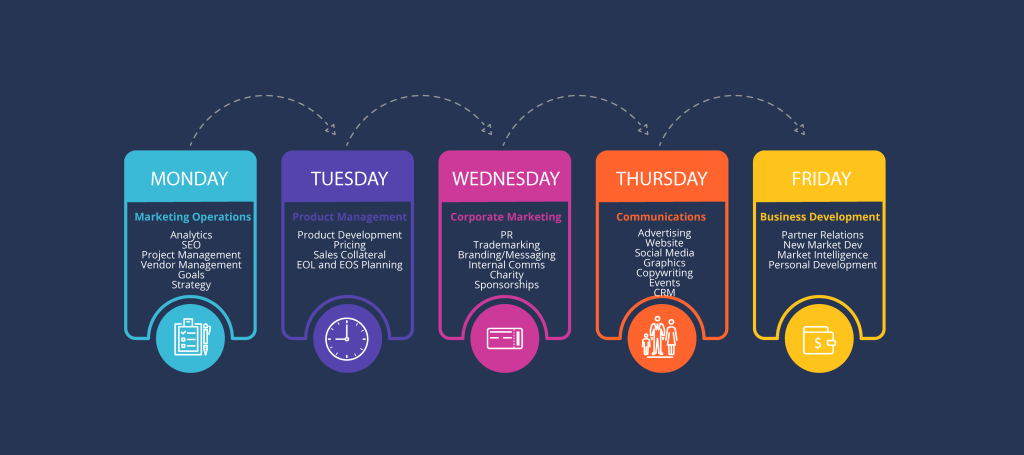
After a couple of mild anxiety attacks, lots of words of encouragement from people, and maybe some alcohol, I realized that I know how to do this. I’m the most organized person I know! This week I’m trying to focus on one type of task per day. For marketers who are responsible for every aspect of a company’s messaging, branding and communication efforts, it can be overwhelming in a non-pandemic scenario. Throw in a couple of kids and a husband, a home office that lacks the delicious coffee of your downtown accommodations and suddenly you’re slipping and sliding through this downward spiral of confusion and frustration and…. what was I talking about?

Exactly. So, I created a task-focused planner for each day of the week to help me stay on track and focused. I placed it eye-level, right in my face, so that anytime I feel myself losing it (in all the ways) I can just glance at my list and see what to do. It has helped me immensely. I almost feel grounded… almost.

This is specific to the types of activities that I manage day-to-day, but I hope it will help you find some mental peace. You can click to see it full size. Good luck everyone!

StoryBrand Workshop – I Did It!

It finally happened. I went to a StoryBrand Workshop! I had the pleasure of experiencing presentations from Donald Miller, JJ Peterson, and Koula Callahan. They did a great job diving deeper into the process that I’ve studied for the past year.

I really wanted to focus on simplified messaging to help get everyone on the same page at CyberMaxx. Step by step, we eagerly worked through each section of the StoryBrand framework along with our certified coaches who made sure we were doing it right and staying on track.

CyberMaxx has already put in a lot of work on the steps of the script. Most of the components are sprinkled throughout print assets and the website. Many of the main objectives of StoryBrand are already implemented, so I was VERY  LUCKY to have a great starting point.

Because of this, about halfway through Day 1 the person sitting next to me asked how long I’ve worked at CyberMaxx, in which I replied, “Well, I just started a couple of weeks ago.” She was super surprised and said, “I would have never known! You sound like you know exactly what you are talking about.” Ha! Always say it with confidence! 😉

Another stroke of luck is that this neighbor is also a fellow technology marketer in the healthcare space! We were able to brainstorm together and bounce ideas off of each other. To top it all off, our coach, Curt, was great.

Once the script was complete and we toasted ourselves with bourbon lollipops, we started in on the sales funnel and implementation of the script. We worked on the one-liner/elevator pitch, which I’ve already refined several times after trying it out on an Account Exec and Engineer.

It was two grueling days. I came home exhausted each night, secretly jealous of the people who came from out of town and didn’t have to go home to cook dinner and wrangle children, but it was worth it! 

Clarify your message, y’all. If you confuse, you lose! https://storybrand.com/

“Building a StoryBrand” – Donald Miller

I’m incredibly excited to share with you “Building a StoryBrand” by Donald Miller. This makes my third time through and I’m confident it can help any company with any communications, branding or messaging. It WILL get your customers to listen! 📣

Donald Miller uses storytelling as his process for guiding marketers to CLEAR and CONCISE messaging. The main objective of “Building a StoryBrand” is to clarify your message so your customers understand what you have to offer.

“If you confuse, you lose.”

Donald Miller helps thousands of businesses clarify their marketing, and in turn those businesses have grown. He’s the CEO of StoryBrand, hosts a podcast and has written several books. Even better, he lives in my town, Nashville, where I hope to attend my first workshop!

“Building a StoryBrand” walks through a framework to create a repeatable, simple and relevant communications program, whether it is an elevator pitch, a speech, or copy on a website. Customers want a brand that helps them survive and an easy to understand message is crucial to that survival. (Think “fight or flight”)

The other most disruptive paradigm shift in Miller’s method is its focus on the customer as the hero, not the brand. I. LOVE. THIS. The story is not about your brand or your company, and truthfully, the customer doesn’t care about your story. It doesn’t tell them why they need your product to survive.

“…the day we stop losing sleep over the success of our business and start losing sleep over the success of our customers is the day our business will start growing again.”

Using his StoryBrand 7-part Framework (SB7), you will be able to identify and define your customer and their problems while guiding them through the decision making process so that they will be successful in achieving their goals and transforming their identity. You establish your brand as the authority to gain their trust and guide them to success. And if that wasn’t enough golden goodness, he also provides a roadmap for implementing this framework into your business in 5 easy steps.

This process is so simple, so easy to follow, it almost seems too good to be true. It just makes TOO much sense! If you think about the scripts for the most successful and entertaining movies, they all follow the same exact plot. Storytelling is ingrained in the human psyche and is as old as time itself, of course, this approach works.

Do your business a favor and pick up a copy of “Building a StoryBrand” right now. And maybe I’ll see you at one of the StoryBrand workshops in Nashville!

“The Agile Marketer” – Roland Smart

Have you ever read something and shouted out loud, “That’s what I’ve been saying!”? For me, I had one of those moments while sitting in a quiet, cigarette-reeked waiting room full of already anxious patients — sorry guys. I’m a pretty vocal person, so when someone matches my sentiment, I can’t help but get excited.

The Agile Marketer” by Roland Smart outlines all the reasons why marketing plans fail and provides solutions and processes to address those failures. See: be agile. This book isn’t just aimed at the tech world but illustrates how those techniques can be applied in any industry struggling to market in a digital world. The secret ingredient? Customer experience. To many, that answer seems like a no-brainer when, in reality, very few brands, services, or companies truly approach their offerings with the customer’s experience at the top of mind.

Roland Smart is the Vice President of Marketing at Pantheon Platform, a website operations platform. He’s all about enriching the customer experience through brand communities, notably as a founder in several start-ups. His expertise in software has guided him through the transition from waterfall product development to Agile product management. In his book, he shares how this modern approach works in any industry and why traditional processes fail in today’s digital world.

The first half of the book focuses on the reasons marketing should adapt to agile practices and the methods you can implement. We are living in the “age of the empowered customer” where consumers make their opinions known, maintain a certain sense of entitlement, and revolve around convenience. This data should empower the marketer because of the endless amounts of information willingly and instantaneously provided. Due to this incredible rate of feedback, it is crucial that marketing and product development operate concurrently from the very beginning. The old methods are impractical, long, and drawn-out, with marketing not included until the end. This is where I shout out loud:

“…marketing tends to join the party late. This is especially true at product-driven companies.”

PREACH! 🙌

In many cases, by the time marketing is included, the product is already on the market. Suddenly there are all these needs and requests to help sales communicate. Rather than marketing being a strategic contributor, in the beginning, the department becomes a service provider of tactical solutions after the fact.

Change is inevitable; having a plan or strategy in place is how you easily adapt to that change. (Side note: I am 100% sure I wrote this statement in a letter to my leadership team some six years ago.) Including everyone in that plan is how to execute and adapt successfully. The Agile methodology does precisely that. It is a group effort, allowing cross-functional partnership and ownership. The entire team champions the plan and owns the results. Meanwhile, needed change is implemented earlier in the process, frequently and based on real-time feedback — this costs less in time, money, and resources.

In the second half of “The Agile Marketer,” Roland describes how Agile can be the vehicle for alignment between innovation and marketing teams. The goal is to get CIO and CMO teams on the same page. While product managers are the stewards of innovation and marketers are the stewards of customer experience, they both work together.

In a traditional sense, Agile is considered the antithesis of long term planning, but to the contrary, Agile and Strategy support one another. Here several exercises are explored to help teams align initiatives in innovation and customer experience. At this point in the book, everything takes quite a turn toward technical and scientific theory. Hold tight because understanding the brain’s interpretation of information is how we manipulate the customer experience.

Whether businesses like it or not, customers will score their experience almost solely on the best or worst peaks of their journey. One single interaction can change the course of your relationship for a lifetime. Roland recommends starting with a reduction in negatives first, then increasing positives.

No matter what industry you are trying to market, the practices and methodologies laid out in “The Agile Marketer” can have a profound effect on your communication and product development projects. You can’t afford to put it off, from increased efficiency to better collaboration, the time to be agile is now!

Hello!

My name is Erin C. Kennedy. I am a marketing professional constantly seeking new ideas and creative ways to market and tell stories.

Why?

  • Because technology changes by the second.
  • Because I am naturally an Investigator on the Enneagram (5w6).
  • Because I’m a huge nerd.
  • Because I am passionate about marketing.

I’ve decided to explore new marketing practices, beginning with Agile Marketing. With the ever-changing landscape of advertising and content, I want to ensure I stay on top of it all!

Along the way, I’ll review books, podcasts, articles and lessons through my blog. Join me on this journey as I weave my way through the complexities of marketing in the 21st century.